
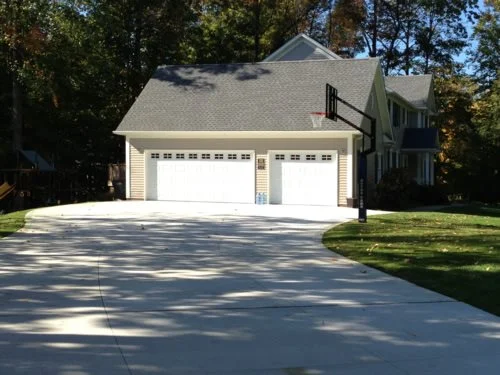
Garage Floor Replacement
Cracked, pitted or flaking garage floor? We remove the old slab completely and pour a new floor built for Ohio winters, heavy vehicles and decades of use.


Why Garage Floors Crack, Pit & Fail
Garage floors in Northeast Ohio take a beating. Your tires track in road salt, it soaks into the concrete, and freeze-thaw cycles push water into the slab until the top layer pops off. That is called spalling. Underneath, a base that was never compacted properly lets the slab settle and crack under the weight of your cars.
We don't patch problems or pour over a failed slab. We take the old floor out, check and fix the base, put down a vapor barrier and pour a new reinforced slab that stands up to moisture, vehicle weight and freeze-thaw.
The Hard-Trowel Finish Difference
A driveway needs a broom finish for traction in rain and snow. A garage floor is different. It is mostly out of the weather and gets foot traffic, tires and often an epoxy coating. A smooth power-trowel finish is the right choice there, and it is what we use on every garage floor we pour.
What We Include on Every Garage Floor
A garage floor is an indoor slab with its own needs, starting with a vapor barrier underneath and a smooth, hard-troweled finish on top.
Why the Vapor Barrier Matters
Moisture from the ground is the hidden problem with garage floors. Without a vapor barrier it wicks up through the slab, which causes sweating, white residue and stains, and it keeps epoxy from bonding. Cheaper jobs often skip the barrier. We always put one down.
The Replacement Process
Jackhammer Removal & Hauling
We break out the old slab with jackhammers, taking care not to damage your walls, foundation block or door frame. All of the concrete is hauled to a certified recycling facility, and the garage is clean when we leave.
Sub-Base Compaction & Vapor Barrier
We check the soil, add new stone and compact it, then lay 6-mil plastic sheeting as one continuous vapor barrier across the floor. The seams overlap and the sheeting runs a little way up the walls.
Wire Mesh & Foundation Dowels
Wire mesh goes in across the whole slab. Where the floor meets the foundation walls, we drill steel dowels into the block and set them in epoxy. That ties the new floor to the building so it does not pull away from the edges over time.
High-Strength Pour & Power Troweling
We pour 4,000+ PSI concrete, level it and finish it with power trowels for a dense, smooth surface. The apron at the door is pitched so water runs out. Isolation joint material goes along every wall before the pour.
Sealing & Curing
We apply a curing compound and sealer to hold in moisture while the concrete gains strength. You can walk on the floor in 24 to 48 hours. We recommend waiting 7 days before you park on it so the slab reaches full strength.
A popular add-on is an epoxy finish. Our hard-trowel concrete finish is the right surface for an epoxy coating, and many homeowners add a full flake or metallic epoxy coating to their floor replacement. Booking both together saves on setup costs and gets the whole garage done in one project. Ask about it when you request your estimate.
Reclaim Your Garage Today
We give free estimates for garage floor replacement in Chagrin Falls, Solon, Beachwood and across Northeast Ohio.
Good to Know
Frequently Asked Questions
How long before I can park my car in the garage?
You can walk on the floor carefully within 24–48 hours. We strongly recommend waiting the full 7 days before driving or parking a vehicle on it. Concrete keeps gaining strength over time. At 7 days it’s at about 70% of its final strength, which is enough for vehicles, and it reaches full strength around 28 days.
Do you seal the new garage floor?
Yes. We apply a high-quality curing compound and sealer immediately after finishing. This helps the concrete cure slowly and evenly (preventing shrinkage cracks) and provides initial protection against oil and staining. If you plan to add an epoxy coating, we'll coordinate timing so the sealer doesn't interfere with epoxy adhesion.
Can you fix the "lip" where my driveway meets the garage door?
Yes. The bump or lip at the garage door is almost always caused by the garage slab settling lower than the driveway apron, or the other way around. When we replace the floor, we re-establish a flush or correctly graded transition so you don't feel it when pulling in. We can also replace the driveway apron at the same time if needed.
Can I add an epoxy coating to the new floor later?
Yes. Our hard-trowel finish is the right surface for an epoxy system. The coating should go on after the concrete has cured for at least 28 days. Many homeowners book the floor replacement and the epoxy coating together so they only pay for one setup and get it all done in one project. We do both, so ask about it when you request your estimate.
How do you avoid damaging my garage walls and foundation during demo?
Near the walls we use careful, targeted jackhammer work instead of full demolition swings. Our crew breaks the slab out in sections, scoring it near the walls and lifting the pieces carefully so we don't hit or undercut the foundation block. We've replaced hundreds of garage floors without damaging a wall or foundation. It's routine for us, and we still take it seriously.
Northeast Ohio Communities We Serve
Request your free estimate
Tell us about your driveway, patio, garage floor, or walkway. We’ll get back to you within 24 hours with clear pricing and no pressure to commit.
Call (440) 720-1175Prefer to talk? Guy answers Monday–Saturday.