
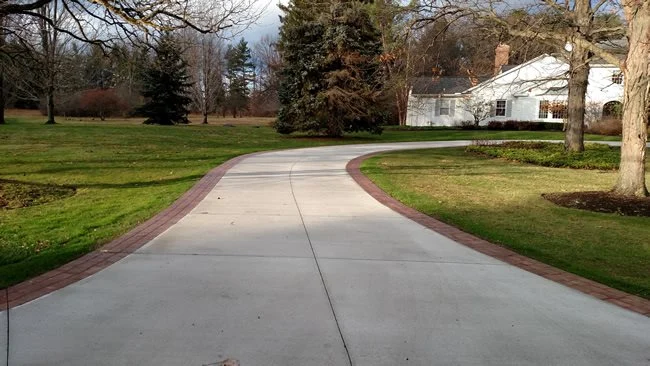
How Thick Should a Concrete Driveway Be in Ohio?
The standard is 4 inches — but heavy trucks, RVs, and municipal codes in the Chagrin Valley can change the calculation. Here is the full technical breakdown from engineers who have poured thousands of driveways in Northeast Ohio.


When is 4 Inches Enough?
A 4-inch slab of properly mixed 4,000 PSI concrete can support roughly 8,000–10,000 lbs of distributed load. Since the average SUV weighs approximately 5,000 lbs, this is more than sufficient for daily residential parking and use.
When Should You Go to 5 or 6 Inches?
Increasing thickness from 4" to 6" increases load-bearing capacity by roughly 50% — a significant structural upgrade. Consider it if any of the following apply:
Heavy-duty work trucks: F-350, one-ton dump trucks, commercial vans with full payloads.
Large recreational vehicles: RVs, boat trailers, or campers parked long-term on the same strip.
High delivery traffic: If UPS, FedEx, or Amazon trucks regularly use your driveway to turn around, the repeated concentrated load adds up.
Weak sub-base conditions: If site conditions reveal wet, unstable, or heavily organic soil after excavation, adding thickness is better insurance than relying solely on base prep.
The Apron: Where Local Code Comes In
The apron is the first 10–15 feet of your driveway connecting to the public street — and it takes the worst punishment of any section. Turning tires, municipal plow trucks, and curb weight concentrate stress right at this transition.
Many municipalities in the Chagrin Valley — including Solon and Beachwood — require the apron to be poured at 6 inches thick by local code. We are experienced in these requirements and factor them into every estimate.
Even where code only requires 4", we standard-spec our aprons at 5–6" with steel dowel tie-ins to the garage foundation. This is the single most failure-prone zone of any driveway — and the one place where extra thickness pays for itself many times over.
The Real Secret: It's All About the Base
You could pour 10 inches of concrete, but if it sits on soft, clay-saturated soil, it will fail. In Northeast Ohio's heavy clay geology, proper sub-base preparation is non-negotiable.
We remove existing material to a minimum of 8"–10" below finished grade to allow for both sub-base and slab thickness.
We install a 4" layer of angular #304 limestone — not round stone, which moves. Angular aggregate locks together under compaction.
We compact the stone with vibratory plate compactors until it is dense and unyielding. This is the step most contractors skip or rush — we never do.
Only after the base is confirmed solid do we form, reinforce, and pour the concrete to the engineered depth.
For most residential driveways: 4" body, 5–6" apron, on 4" compacted #304 stone.
If you have RVs, heavy trucks, or soft site conditions, we'll recommend a 5–6" full slab. We evaluate every property individually — the right answer depends on your specific soil and usage.
Quick Navigation
When 4" is Enough When to Go 5–6" Apron Code Requirements The Sub-Base Secret Free Estimate Get Expert Advice We'll evaluate your soil, usage, and local code — and tell you exactly what thickness and base spec your property needs.
Related Articles
Get the Right Thickness for Your Property
We'll evaluate your soil conditions, vehicle usage, and local code requirements — and give you a clear, itemized estimate with no surprises.
Request your free estimate
Tell us about your project — driveway, patio, garage floor, or walkway. We respond within 24 hours with honest, transparent pricing. No pressure, no obligation.
Call (440) 720-1175Prefer to talk? Guy answers Monday–Saturday.