
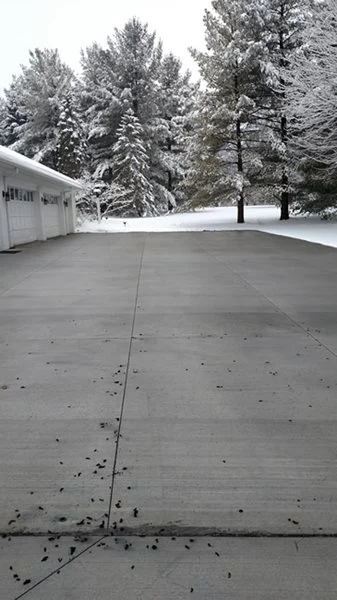
Concrete vs. Asphalt Driveways in Northeast Ohio
Both will get your car from the street to the garage. The difference shows up over 20 or 30 Ohio winters, in how often you’re sealing and patching, and in when you have to pay to tear it out.


How Each One Is Built
Asphalt is stone held together with a petroleum binder. It’s laid hot, rolled flat, and stays slightly flexible for its whole life. Concrete is stone, sand, and cement that cure into a rigid slab. It doesn’t flex, so it depends on a solid base and control joints to handle ground movement.
That difference drives almost everything else: how each surface handles heat and cold, how it wears, and what it takes to keep it in shape.
Ohio Winters
Freeze-thaw is the big test here. Water gets into the surface, freezes, expands, and slowly breaks it apart. Asphalt can flex with small movements, but water that gets under it softens the base and leads to potholes and spiderweb cracking, especially along the edges.
Concrete handles freeze-thaw well when it’s mixed and built for it. We pour a 4,000+ PSI air-entrained mix, and the tiny air bubbles in it give freezing water room to expand without breaking the surface. A compacted stone base and control joints in the right places take care of the rest.
Road salt is harder on concrete than on asphalt, which is why a penetrating sealer matters. Applied about a month after the pour and renewed every few years, it keeps salt water from soaking in.
Summer Heat
Asphalt is black and softens in the heat. On a hot July afternoon it can scuff under turning tires, and a kickstand or trailer jack can sink into it. It also holds heat, which you notice walking on it barefoot.
Concrete stays hard and lighter in color. It doesn’t soften, and it stays cooler underfoot.
Upkeep Over the Years
Asphalt: Sealcoating every few years to keep the surface from drying out and turning gray, plus crack filling and patching as it ages.
Concrete: A penetrating sealer every 3–5 years on a plain broom finish, and a rinse in the spring to get road salt off.
Neither one is maintenance-free. Concrete just asks for less, and less often.
Cost Up Front vs. Cost Over Time
Asphalt almost always costs less to install. Concrete costs more on day one, and how much more depends on the size of the driveway, how much old material has to come out, and the condition of the base.
Over the long run the math changes. A well-built concrete driveway can last 30 years or more with basic sealing, while an asphalt driveway usually needs to be resurfaced or replaced sooner. If you plan to stay in the house, concrete usually works out to the better value.
When Asphalt Makes Sense
If the budget is tight, the driveway is very long, or you plan to sell soon, asphalt can be the practical choice. For most homeowners who want to do the driveway once, concrete is worth the extra cost up front.
We pour concrete, so we’re not neutral. But if your situation points the other way, we’ll tell you.
Good to Know
Frequently Asked Questions
Can you pour concrete over an old asphalt driveway?
No. Asphalt flexes and holds moisture, so a slab poured over it has nothing solid underneath and will crack. We remove the asphalt completely, fix the base, and pour on compacted stone.
How long does a concrete driveway last in Ohio?
Built on a compacted base with air-entrained concrete and sealed on schedule, 30 years or more is realistic. Driveways that fail early almost always come down to a thin slab, a poor base, or no reinforcement.
Is a concrete driveway slippery in winter?
A broom finish gives concrete good traction in rain and snow. On steep driveways we can add more texture, and exposed aggregate is another option if grip is a concern.
Request your free estimate
Tell us about your driveway, patio, garage floor, or walkway. We’ll get back to you within 24 hours with clear pricing and no pressure to commit.
Call (440) 720-1175Prefer to talk? Guy answers Monday–Saturday.