
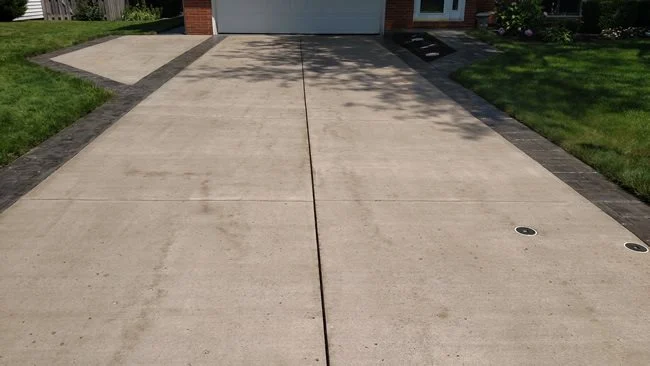
Concrete Driveway Cost Factors in Ohio
Why does one quote say $5,000 and another say $10,000 for the same driveway? The answer is almost always the sub-base. Here is an honest breakdown of every cost driver in Northeast Ohio.


1. Demolition & The “Double Tear-Out”
Removing your existing driveway is the first significant cost driver. In older Cleveland suburbs — Shaker Heights, Mayfield, Chesterland — we frequently encounter a “double tear-out.” A previous owner paved asphalt directly over the original concrete instead of replacing it.
Removing both layers substantially increases debris volume, hauling fees, and labor hours. The difference can be $1,000–$2,500 on a standard residential driveway. A quality estimate will always specify demolition depth and hauling inclusion — if it doesn’t, ask.
2. The Sub-Base & Northeast Ohio Clay
Northeast Ohio sits on some of the heaviest clay soil in the region. Clay behaves like a sponge: it absorbs water, then expands dramatically when that water freezes. If concrete is poured on a poorly prepared base, heaving and cracking are inevitable — typically within 5–8 years.
Proper pricing includes excavation to appropriate depth, removal of unstable material, and a compacted layer of #304 angular limestone . This stone base acts simultaneously as a drainage layer and a shock absorber. It is the single most important factor in how long your driveway lasts.
3. Reinforcement & Mix Strength
Concrete is extraordinarily strong in compression but relatively weak in tension. Reinforcement holds the slab together if the ground beneath it ever shifts. We use 6×6 wire mesh throughout every residential driveway — not because it prevents all cracking, but because it prevents sections from separating or sinking when a hairline crack does form.
Mix design matters equally. We specify a minimum 4,000 PSI air-entrained mix for all exterior flatwork. Air-entrainment creates microscopic bubbles in the concrete that give water room to expand during freeze-thaw cycles — dramatically reducing surface scaling from road salt.
PSI (pounds per square inch) measures compressive strength. A 3,000 PSI mix — common in budget bids — is 25% weaker and significantly more porous. In Northeast Ohio’s freeze-thaw climate, that porosity means road salt penetrates deeper and causes spalling (surface flaking) years earlier. The cost difference between a 3,000 and 4,000 PSI load is minimal. The lifespan difference is not.
4. Finish & Decorative Options
A standard broom finish is the most economical and delivers excellent traction for Ohio winters. Upgrading the finish adds cost in two ways: materials and specialized labor time.
Stamped borders or full patterns: Require rubber stamps, color hardeners, and release agents. Labor is more time-intensive because the window for stamping is narrow.
Integral color: Pigment is mixed into the concrete itself — the color goes all the way through, so chips don’t show bare concrete. Adds material cost but is far more durable than surface-applied color.
Exposed aggregate: The surface paste is washed away to reveal the natural stone aggregate below. Achieves a textured, slip-resistant finish with a natural aesthetic popular in Moreland Hills and Gates Mills.
Good to Know
Frequently Asked Questions
Does slab thickness affect the price?
Yes, significantly. Standard residential is 4 inches. Upgrading to 6 inches for heavy vehicles — RVs, work trucks, boat trailers — increases concrete volume by 50%. The apron (where the driveway meets the street) is typically poured at 5–6 inches regardless of the driveway body, because it takes the highest concentrated load from turning vehicles and municipal plow trucks.
Do I need a permit in Solon or Beachwood?
Yes. Both cities require permits and inspections for driveway replacement. Beachwood is particularly strict about apron thickness (minimum 6 inches at the street connection). We handle the full permit application, scheduling, and inspection coordination — it is included in our process, not an extra charge.
Why is one quote $4,000 and another $9,000 for the same driveway?
The gap almost always reflects what is — and isn’t — included in the sub-base. A $4,000 quote may pour directly on existing gravel or clay, use a 3,000 PSI mix, and skip reinforcement. A $9,000 quote may include full demolition, 4 inches of compacted limestone, wire mesh, a 4,000 PSI air-entrained mix, and proper control joint cutting. The concrete truck is the same. The engineering is completely different.
When is the best time of year to get an estimate?
Winter is the ideal time to get your estimate and get on the Spring schedule. Our calendar fills quickly once weather permits pouring. Homeowners who contact us in January and February typically get their preferred installation window. Spring walk-ins often wait until summer or fall.
Request your free estimate
Tell us about your project — driveway, patio, garage floor, or walkway. We respond within 24 hours with honest, transparent pricing. No pressure, no obligation.
Call (440) 720-1175Prefer to talk? Guy answers Monday–Saturday.